MOSS · litter-picking rover · open source · V0.6 · R92 files available
Cleaner streets, one maker at a time.
A small, mostly 3D-printed rover with a bin and an arm derived from the SO-101, made to pick up litter where you live. Print it, build it, improve it, run it. Code, design files and data are open.
The build, day by day
Drives as soon as the battery switch is on: the stack starts at boot, no deadman, a GameSir pad on its 2.4 GHz receiver. Sound from the rover's own amplifier and speaker. Six minutes of driving indoors on one charge, driver and motors cool after it. The cockpit gets a Simple view for the phone. Print plates and BOM updated: four-port hub, the pad, all spacers on one plate.
18 OCTReady-to-print plates: one project for the H2S (one-piece hull and cover), one for the P1 / P2 (split hull and cover). The package gains both Jetson retaining tabs and grouped STLs with quantities.
16 OCTV0.6 / R92 CAD, STL files, BOM and build guide are public. Choose one-piece or two-piece hull and cover, plus the computer and camera carriers you need.
13 OCTNew drivetrain measured on the floor: 90:1 motors and a 10 A dual driver, 0.32 m/s flat out, 17,190 encoder ticks per metre against a tape measure.
11 OCTThe dimOS software moves into the repository: base, lidar odometry, map, planner, explorer, pad, recorder, flight check, launcher and cockpit.
10 OCTFirst drive at the gamepad through dimOS, arm mounted: forward, reverse, turns, pivots. The 3 A driver and the 56:1 motors leave no headroom; a 10 A driver and 90:1 motors are next.
1 OCTV0.5, redrawn on the real robot: one-piece hull, two tensioners per track, mounts for every board, magnets for the bin. 107 printed parts.
26 SEPArm and gripper on the rover.
24 SEPV0.4: revised hull, screw-terminal controller, one dual motor driver.
22 SEPFirst drive. The single-sided track adjustment leaves the tension uneven: a second tensioner per track goes into V0.4.
20 SEPBoth motors and encoders run for the first time from the ESP32-S3. By the evening the electronics are in the chassis and the Jetson boots on battery.
19 SEPThe whole print set is on the bench: 113 parts, plus shafts, bearings and screws.
18 SEPThe chassis comes off the printer in black PETG. First fit check on the bench.
16 SEPFirst prints on two printers: the bin in PLA, a flexible track in TPU.
15 SEPConcept video. Target: about 500 to 700 USD in parts plus a Jetson. The repo starts.
Every step is written down when it is real, good or bad: build log, what did not fit.
What is inside
| BRAIN | Jetson Orin Nano Super or Raspberry Pi 5, using the matching printed carrier |
| EYES | Intel RealSense D455 or Orbbec Gemini 2 at the nose, using the matching camera insert; a colour camera in the hand |
| LIDAR | SLAMTEC RPLIDAR C1, 2D, for odometry and the map |
| MOTOR CONTROL | QT Py ESP32-S3 over serial, Cytron MDD10A Rev2 dual driver, 90:1 geared motors at 110 rpm with Hall encoders |
| ARM | SO-101-derived arm, five ST3215 servos, parallel gripper derived from the NormaCore NC90 with a CF35-12 servo |
| POWER | 3S pack, inline fuse, INA219 for battery voltage |
| SOUND | MAX98357A amplifier on the Jetson's I2S and a 3 W speaker |
| PAD | GameSir Nova 2 Lite on its 2.4 GHz receiver; a four-port USB hub carries the receiver, the wrist camera and the lidar |
| PRINTED | 106–109 catalogue pieces depending on the selected hull, cover and camera options; PETG, PLA and TPU 95A |
| SOFTWARE | dimOS on the Jetson: lidar odometry, map, planner, explorer, pad teleop from the battery switch, a web cockpit with a phone view; firmware on the QT Py ESP32-S3 |
What does it cost
Base assembly: about $460. Includes the chassis and tracks, arm and gripper, motors, servos, control electronics, power system, wrist camera, 2D lidar, wiring and filament. Only the computer and navigation camera are additional.
Add one computer and navigation camera configuration: Jetson + RealSense, or Pi + Hailo + Gemini, or Pi + Mighty.
| OPTION 1 | Jetson Orin Nano Super, RealSense D455 | +$930 |
| OR OPTION 2 | Raspberry Pi 5, Hailo AI HAT, Gemini 2 | +$740 |
| OR OPTION 3 | Raspberry Pi 5, Mighty camera | +$400 |
Approximate parts costs in USD. Option prices exclude the base assembly. See the BOM for components and hardware.
Try the demo
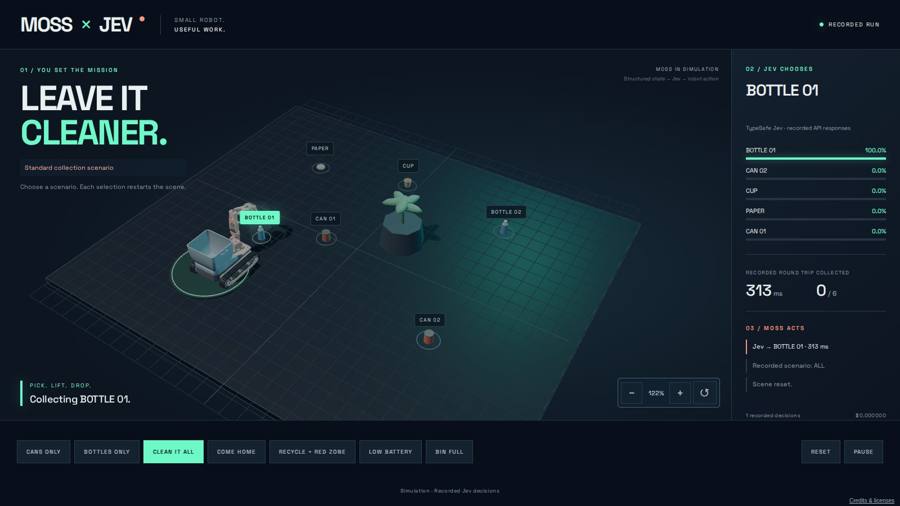
Jev, TypeSafe AI's decision model, chooses every step of a pickup, approach, align, grasp, lift, carry, release, on physics recorded once in MuJoCo and replayed in your browser. Three missions with real Jev decisions, plus the earlier target-choice scenarios.
Build one, or come and watch
The V0.6 / R92 design files and build guide are available now. Print the parts you need, order the components, then follow the assembly steps one at a time. Kits are coming soon on TNKR: join the waitlist if you prefer to skip printing and sourcing. Questions and build feedback are welcome on Discord.